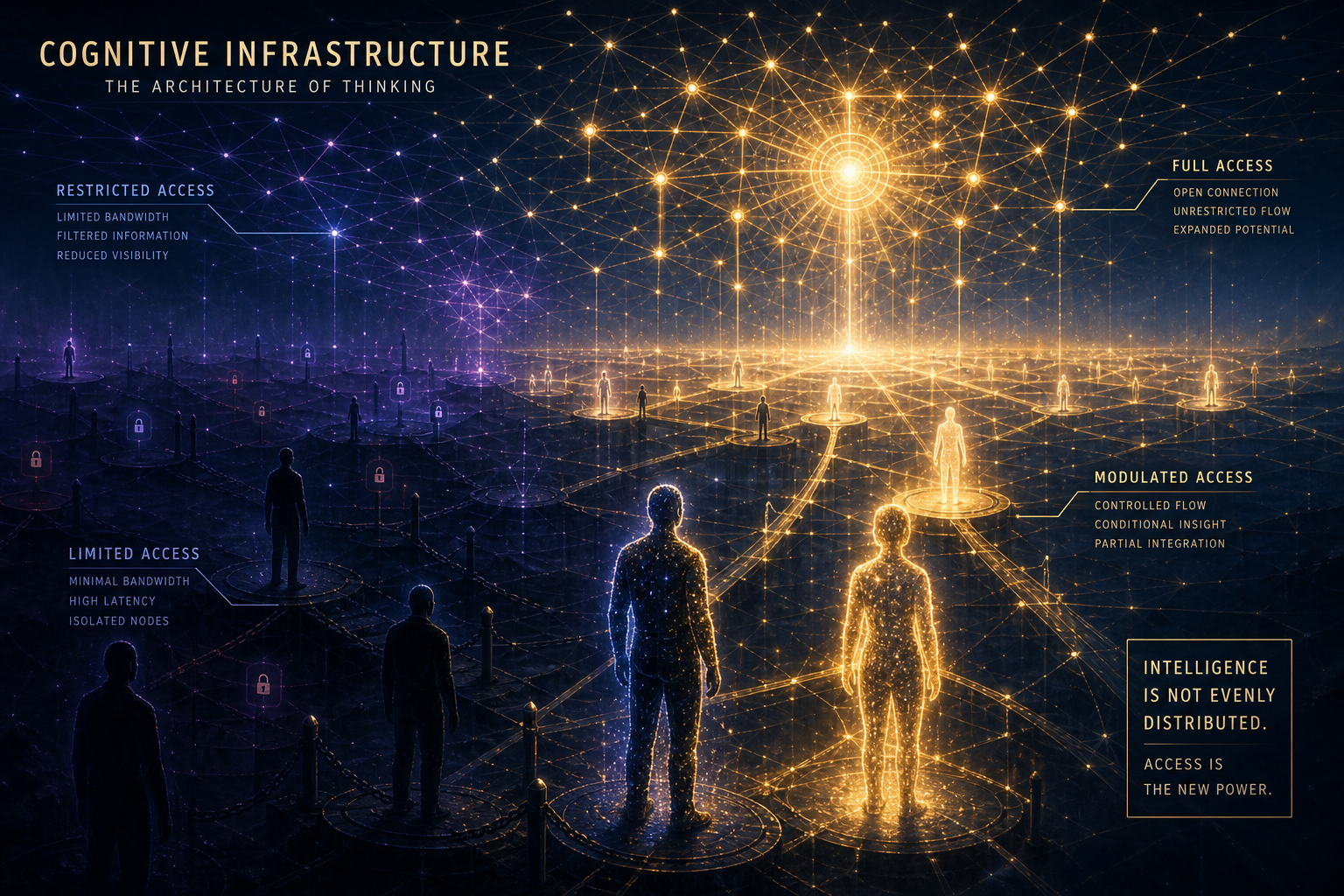
The Infrastructure of Thought
There was a time when a nation’s wealth was measured by its arable land. Later, after the arrival of the first steam engines, by its industrial capacity. And today, by whoever dominates knowledge. Each of these transitions redefined who exercises power, who weakens and becomes necessary but dependent, and who is left outside the system.
In this era, we are witnessing a transition of that nature: artificially amplified intelligence is becoming strategic infrastructure, and its unequal distribution, as history has shown us time and again, will necessarily produce forms of dependency that, incidentally, we still do not fully understand.
Artificial cognitive amplification—the speed of analysis, extended memory, agents operating in parallel on complex tasks—already exists as a technical and commercial reality.
In this chapter, we will explore how this technology can become an unprecedented threat to the sovereignty of nations, and how it could reconfigure international geopolitics through the distributed control of the quintessential human resource: intelligence.
The Token as a Political Unit
The philosopher Yuk Hui argues that politics and technology are inseparable spheres. Technology organizes power, knowledge, and the world; and it always does so under specific logics that favor certain actors and necessarily displace others.
A token—the minimal unit through which language models operate—can be understood as a universal unit of access to cognitive power.
In this way, we can understand that whoever controls that infrastructure controls the conditions of action and thought at a collective scale.
From this perspective, a country lacking digital sovereignty will end up building a structural relationship of dependency regarding the cognitive resource. If the most capable models, the most powerful compute, and the most advanced agent systems are located and controlled by a group of private actors concentrated geographically, decisions about access, price, availability, and usage limits are made by those actors. Countries that lack their own infrastructure delegate, at least partially, the conditions under which their society can think, produce, and decide.
The Rate of Thought
The most precise economic analogy to describe this phenomenon is the interest rate. When the cost of credit rises, certain projects cease to be viable: profitability is not enough to sustain the financial cost. Expensive money decides what gets built and what gets discarded.
The cost of compute operates with an analogous logic. If processing certain analyses, training certain models, or deploying certain agent workflows has a prohibitive cost for certain actors, those cognitive projects simply do not happen. The cost of intelligence as the determining factor of what gets thought and what does not.
This could be called the rate of thought. The concept indicates that differential access to compute generates, through accumulation, structural cognitive asymmetries. Whoever can pay for more tokens has more speed, more processing, and more refinement. Whoever accesses the best models makes the best decisions. Whoever makes the best decisions accumulates more resources and, with those resources, finances more access to assisted intelligence. A virtuous—or vicious, depending on where we look from—circle by which techno-cognitive concentration feeds back into itself and deepens.
Modulation and Dividuals
The French philosopher Gilles Deleuze warned that contemporary power is no longer exercised primarily in the classical form of discipline. Where the latter enclosed and prohibited categorically, contemporary control power modulates: it establishes variable accesses, differential permissions, and dynamic limits. The boundary between inside and outside becomes a gradient: one is inside, but at a certain speed; one has access, but to a certain number of operations; one can use the system, but at a certain price that fluctuates according to demand.
Applied to the economy of AI, Deleuzian modulation precisely describes what is already happening. Few actors will be directly excluded from the system; most, instead, will be modulated in their cognitive access: a certain memory context, a certain number of concurrent agents, a certain model quality. Assisted intelligence thus becomes a regime of access rather than a stable attribute: one has access to the intelligence that one is granted.
Deleuze also introduces the notion of the dividual: in contrast to the classical individual—an indivisible unit, a subject of rights and consciousness—the dividual is a profile decomposed into variables, flows, and manageable data. This decomposition has its cognitive version in the economy of AI. Thought is fragmented into tasks, subtasks, prompts, automations, and flows orchestrated by agents. The mind, in this scheme, ceases to be solely a subjective faculty and also becomes a set of operations that can be industrialized, outsourced, and ultimately administered.
If manual labor was industrialized in the nineteenth century and knowledge work in the twentieth, AI inaugurates the industrialization of the mind. All industrialization historically implies relations of production, property, and differential access.
The Inequality That Cannot Be Seen
The most visible inequality is measured in income, assets, or, more essentially, in access to basic services. The cognitive inequality introduced by AI is harder to perceive because it does not involve depriving anyone of something they previously had. It involves amplifying the capabilities of some at a speed that others will not be able to follow.
Those who operate with agents capable of analyzing thousands of documents simultaneously, synthesizing dispersed information, generating hypotheses in seconds, and iterating on them without stopping, do not just work faster: they think differently. They have access to patterns that unassisted analysis cannot detect, to connections that individual reasoning cannot construct, to decision speeds that manual deliberation cannot reach. The gap between that actor and another who works without those tools ceases to be quantitative and becomes qualitative.
Cognitive inequality is not, then, a lateral consequence of the AI economy: it is its most important structural product. Unlike other inequalities, it accumulates quickly, feeds back on itself, and proves difficult to compensate with conventional redistributive policies, because compensating for differential access to an ever-expanding infrastructure requires a different kind of intervention than the simple redistribution of an existing good.
The Risk of a Single Grammar
Yuk Hui introduces a critical concept for thinking about this problem in its most representative dimension: technodiversity. Technical diversity is a condition for different forms of intelligence, temporality, imagination, and collective life to subsist. When it disappears, not only are technological options lost: forms of existence are lost.
The risk Hui points to is that a global economy of agents will impose, by inertia of scale, a single technical grammar of intelligence: optimization, efficiency, prediction, coordination. Not because someone explicitly decides it, but because the systems that maximize those values are the ones that are trained, deployed, and reproduced on a planetary scale. The problem becomes what type of intelligence becomes universal.
A single universalized technical architecture can degrade forms of knowledge that do not adapt to its parameters. Forms of thought that operate through slow accumulation, deliberation, communal intuition, long memory, or non-linear logics are at a disadvantage against systems designed to produce fast, scalable, and optimized responses. Technical homogenization poses, in this sense, a civilizational risk that exceeds the discussion about markets or regulations.
Hui proposes thinking about this problem from what he calls planetary thinking: a perspective that surpasses the framework of the classical nation-state and recognizes that AI poses challenges irreducible to the political categories of the twentieth century. Sovereignty, in this context, also increasingly passes through control of the infrastructure that amplifies intelligence.
The Administration of Intellectual Power
The most terrifying conclusion of the argument is that some actors will be able to decide how much others can think.
In the practical and structural sense of keeping certain countries, regions, or sectors in a condition of cognitive under-provision: with more expensive, more limited, more delayed access to the systems that amplify collective intellectual power.
That goes beyond inequality. It is an asymmetric administration of intellectual power. And this distinction matters because it changes the nature of the political problem. An inequality can be addressed with redistribution; an asymmetric administration of cognitive access implies that whoever administers it has an active interest in maintaining the asymmetry, because that asymmetry is precisely the source of their advantage.
The conceptual tools of classical economic regulation—antitrust, universal access, public goods—are the necessary starting point, although they prove insufficient for the scale of the problem.
What is missing is a political theory of cognitive sovereignty: what it means for a political community to maintain control over the conditions under which it can think, deliberate, produce knowledge, and make collective decisions.
The Politics of Thought
A civilization in which intelligence is privatized, hierarchized, and geopolitically administered does not only produce economic inequality. It produces an insurmountable asymmetric cognitive dependency. It materializes an epistemic subordination. It produces entire societies condemned to think with foreign tools, under foreign logics, and within limits strategically set by others.
And when a nation loses control over the infrastructure that amplifies its capacity to think, what it loses is, ultimately, its own sovereignty.